
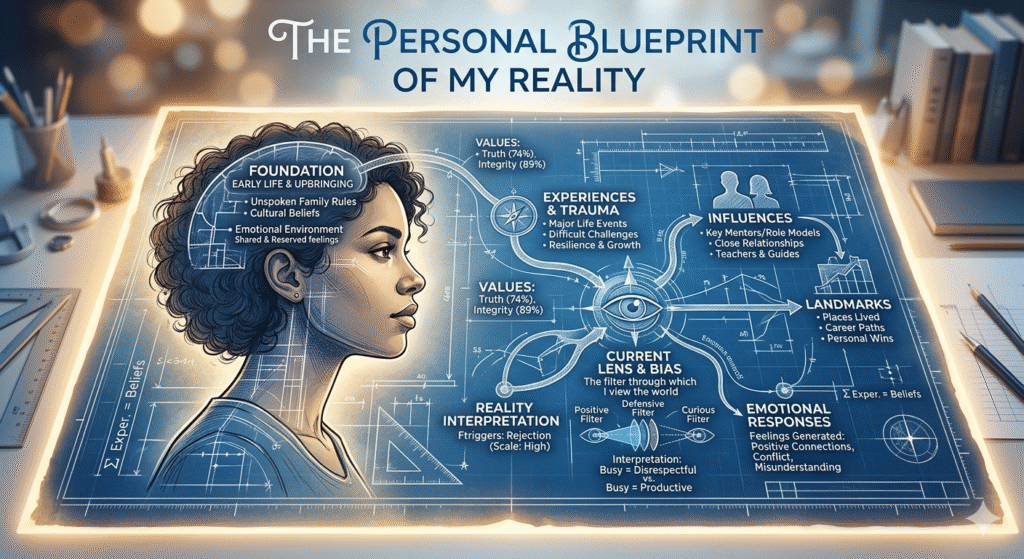
We often think of our reactions as objective truths, but in reality, we are all operating from a specialized set of internal schematics. Throughout our lives, we have been drafting what can be called a Personal Blueprint.
This map is drawn from the foundation of our upbringing, the landmarks of our personal experiences and traumas, the environments where we’ve lived, and the architects—the influential people—who crossed our paths. This blueprint is the lens through which we view every interaction, interpretation, and emotional response.
When your blueprint aligns with someone else’s, the connection feels effortless—a “click” of mutual understanding. However, when blueprints clash, misunderstandings are almost inevitable. We don’t see the world as it is; we see it through our specific plans.
If a colleague or friend is short in a text message, one person’s blueprint might read it as “they are busy,” while another’s (perhaps shaped by past volatility) reads it as “they are angry with me.” The emotional impact—whether positive or negative—is felt instantly, dictated by those old lines on your map.
Understanding your own blueprint is essential, but the real breakthrough in mental wellbeing happens when we appreciate that every individual around us is operating on an entirely different set of plans.
Self-awareness is the first step toward emotional freedom. Reflect on these areas to see how your map was drawn.
The Foundation (Upbringing): What was the “unspoken rule” in your house regarding expressing emotion or handling conflict?
The Landmarks (Key Experiences): Identify three significant life events (positive or negative) that changed how you trust or view others.
The Architects (Influences): Who are the two people who most shaped your core values? Are those values still serving you today?
The Default Lens: How would you describe your initial “filter” when meeting someone new? (e.g., Guarded, Open, Analytical, People-pleasing?)
Use this worksheet when you feel a “clash” or a sharp emotional reaction to someone’s behavior.
The Event: (e.g., A friend didn’t check in on me after I mentioned I was stressed.)
My Blueprint Interpretation: (e.g., “They don’t care about my well-being.”)
The Emotional Impact: (e.g., I feel lonely, unimportant, or resentful.)
The Alternate Schematic: (What is a version of this story where their blueprint is different? e.g., “They grew up in a family where ‘giving space’ was the highest form of respect.”)
The Adjusted Response: How can I react based on curiosity rather than my own blueprint bias?
When you feel a sharp negative emotion, pause and ask: “Is this about what they actually did, or is this a line in my blueprint reacting?” Distinguishing between the two prevents unnecessary conflict.
Instead of assuming intent, ask questions. Phrases like, “I’m curious how you’re viewing this situation,” allow others to show you their map without feeling judged.
Just because a blueprint was drawn years ago doesn’t mean it’s still accurate. You have the power to “redline” old interpretations and choose new, healthier ways of seeing the people around you.
Dave Smith is a professional coach and consultant dedicated to helping individuals navigate life’s major transitions with clarity and purpose. As the founder of the Leap Retirement Dave combines executive leadership experience with a deep understanding of human behavior to help clients rewrite their personal blueprints for a more fulfilling, connected life. (now & in retirement).