
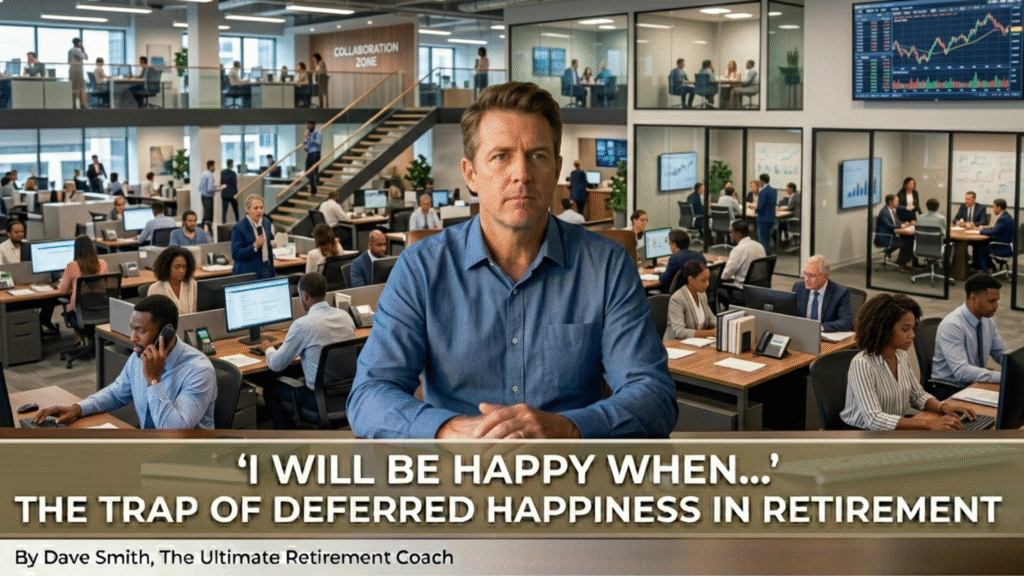
We’ve all said it. It’s the internal narrative that keeps us grinding through the 50-hour work weeks and the high-stress boardrooms.
“I will be happy when I finally retire.” “I will be happy when the mortgage is paid off.” “I will be happy when I hit that magic number in my 401(k).”
As a retirement coach, I spend my days helping high-achievers navigate the transition from a career-driven identity to whatever comes next. What I’ve discovered is that “happiness” is often treated like a destination we haven’t reached yet. But when my clients finally pull the lever and “arrive,” the reality is often more complex than they imagined.
Here are the top five things we believe will bring us ultimate happiness, the reality of achieving them, and what those who have “made it” actually have to say about the experience.
We are conditioned to believe that a specific net worth is the gateway to permanent peace of mind. We think that once the “number” is hit, anxiety will simply evaporate.
The Reality: Financial security is a foundation, not a skyscraper. Once the basic needs and comforts are guaranteed, the “happiness ROI” on every extra dollar drops significantly.
The Feedback: One of my clients, a former executive who hit his “number” five years early, told me: “I spent thirty years thinking the money was the shield. But once I had it, I realized it doesn’t protect you from boredom or a lack of purpose. It just gives you a more expensive place to feel restless.”
The vision of sitting on a beach or playing 36 holes of golf every day is the most common retirement trope. We think total freedom from responsibility is the peak of human existence.
The Reality: Leisure is a wonderful dessert, but it makes for a terrible main course. Without the contrast of effort or “work” (in whatever form that takes), leisure quickly loses its flavor.
The Feedback: A retiree who spent his first six months traveling the world shared this: “The first three weeks were bliss. By month four, I felt like a ghost. I was consuming experiences but contributing nothing. I didn’t need a vacation; I needed a reason to get out of bed.”
Whether it’s the custom-built dream home on a few acres or the downsizing to a luxury condo, we place a massive amount of weight on our physical surroundings.
The Reality: Humans are incredibly good at “hedonic adaptation.” We get used to the view, the high-end finishes, and the extra space within months.
The Feedback: “We built the dream house with the exact workshop and kitchen we wanted,” a client told me. “It’s beautiful. But the house didn’t fix the fact that my kids are grown and live three states away. The walls don’t provide the connection I was actually looking for.”
We think that reaching the top of the mountain—the “Global Director” title or the “Industry Expert” status—will provide a lasting sense of self-worth.
The Reality: Titles are borrowed; they aren’t owned. When you leave the building, the title stays behind. If your happiness is tied to your business card, retirement can feel like an identity crisis.
The Feedback: A retired CEO once told me: “The day after I retired, the phone stopped ringing. I realized people weren’t calling me because they liked me; they were calling the chair I sat in. If I hadn’t built a life outside that chair, I would have been devastated.”
We think that being the “master of our own time” is the ultimate win. No bosses, no clients, no schedules.
The Reality: Total autonomy can lead to total isolation. Human beings are hardwired for community and collaborative effort.
The Feedback: As one retiree put it: “I thought I hated schedules. It turns out, I just hated bad schedules. Without a ‘why’ and a ‘who,’ having 24 hours of free time felt less like freedom and more like a vacuum.”
If the “When/Then” mindset is a trap, how do we actually find fulfillment? Here are two things you can start doing today:
1. Retire To Something, Not From Something Happiness in retirement isn’t the absence of work; it’s the presence of meaningful engagement. Whether it’s mentoring, starting a boutique business, or mastering a difficult craft, you need a “North Star” that requires effort and offers growth.
2. Invest in “Social Capital” Early Your 401(k) will fund your lifestyle, but your relationships will fund your happiness. Those who report the highest satisfaction in retirement are those who maintained deep social benches before they left the workforce. Don’t wait until you’re retired to find your community.
Final Thought: Don’t wait for a date on the calendar to be happy. If you can’t find a way to be content with a “work in progress” life today, a “finished” retirement won’t solve it for you.
Dave Smith is a Certified Professional Retirement Coach (CPRC) helping individuals design a retirement that is as productive as it is peaceful.